Local detail
The Problem
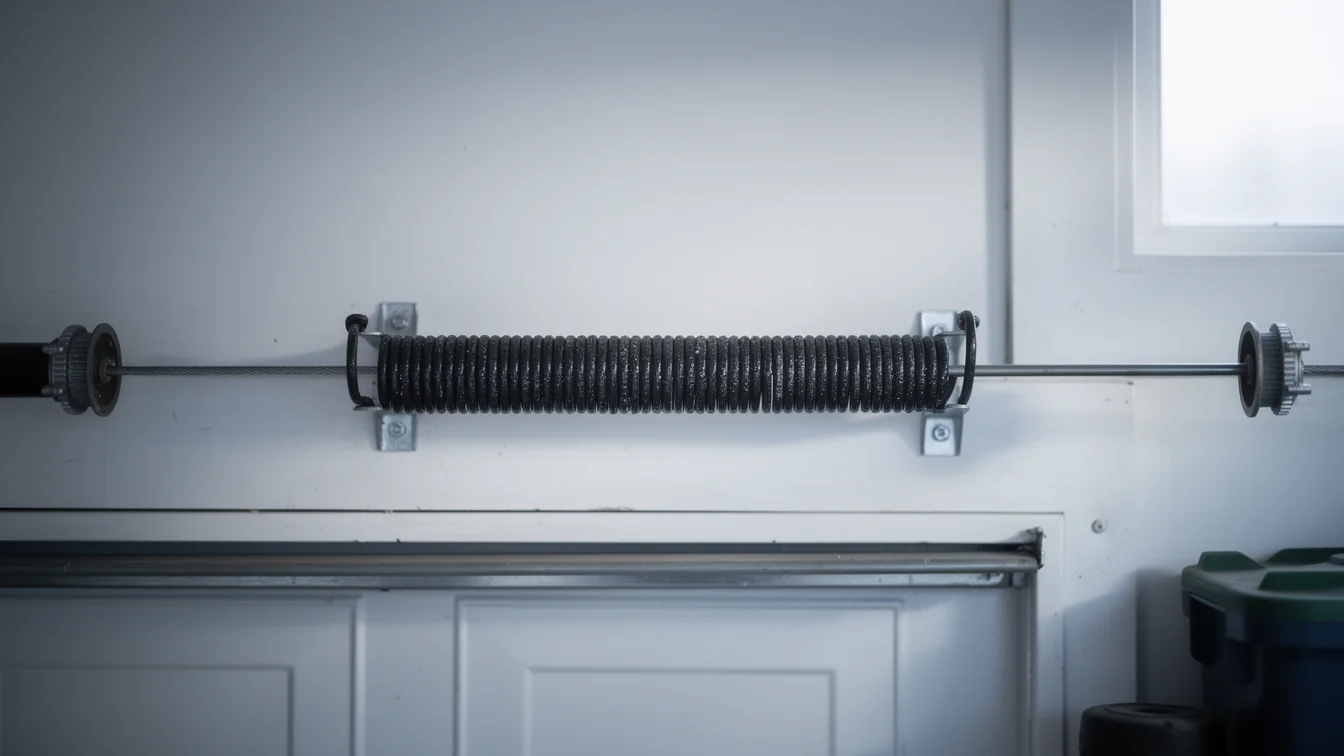
A torsion spring doesn't care about the forecast most of the year in Mesquite. It cares about cycles - how many times it's wound and unwound lifting a door that can weigh over a hundred pounds. What changes when a cold front comes through is the metal itself. Steel contracts as it cools, and a spring that's already fatigued from years of heat-cycling loses what little flexibility it had left. That's the moment it lets go, usually on the coldest morning of the stretch, usually with no warning beyond a loud bang in the garage. Across the houses we see from Creek Crossing Estates out toward Heritage Park and Pleasant Grove, the pattern is consistent: the spring doesn't fail because it's cold, it fails because cold is the final stress on a part that was never rated for a long service life in the first place. If your door was fine on Tuesday and won't lift Wednesday morning after a hard freeze, that's not bad luck. That's a spring at the end of its cycle count, and the cold just picked the day.
The area
What Most People Get Wrong
Most homeowners assume a spring breaks from cold the way a pipe bursts - a direct weather event. It doesn't work that way here. With housing across this service area built mostly between 1973 and 2013 (median around 1998), the majority of torsion springs we replace are original or close to it, meaning they were speced for a climate that's heat-dominant most of the year, not for sustained cold. People also assume lubricating the opener chain or track will help a stiff, cold-morning door. It won't touch the actual problem, which is spring tension, not friction. The other mistake is waiting. A spring that's visibly stretched or has a gap in its coils isn't going to tighten back up once the weather warms. It's going to be the next 20-degree morning's failure instead. We don't recommend patching a spring with a gap in the coil - once it's stretched that way, it's done, and running it anyway risks the cable and drum too.
What we find
How Local Conditions Play In
The housing stock across the 20-some communities we work in, from Sunnyvale and Balch Springs in close to Seagoville, Heath, and out past Crandall and Kaufman, skews 1980s and 90s construction. That generation of garage door hardware was built around the assumption of a long, hot stretch with only occasional sharp cold snaps - which is exactly this area's climate pattern. The springs weren't engineered with a cold-climate coil gauge the way you'd see further north. So when temperatures actually drop for a stretch of days, the springs in these original installs are operating outside the range they were really designed for, on top of whatever fatigue they'd already built up from 20-plus years of heat cycling. That combination - older hardware plus a short, sharp cold snap - is the specific failure pattern we see repeat house after house in this stretch, more than in a climate that's cold all winter and where hardware gets speced for it from day one.
How we work
Season by Season
Spring and summer in this area put the most cycles on a door - pool parties, yard work, kids in and out - but the heat doesn't usually snap a spring outright, it just wears it down. Fall is quiet. Winter is when the bill comes due: a front moves through, temperatures drop for a few days, and that's when a spring that's been losing coil tension all year finally gives out. If your door is original to a house built in that 1980s-90s window, winter is the season to have it looked at before the cold does the deciding for you. We won't tell you to replace a spring that still has even coil spacing and no rust pitting just because the season changed - that's money you don't need to spend. But if it's original hardware and you've never had it serviced, a pre-winter check costs a lot less than an emergency call on a Saturday morning when it's 28 degrees and the door won't budge.
Talk to a local pro
Garage door trouble in Mesquite?
Same-day service with honest, upfront quotes.